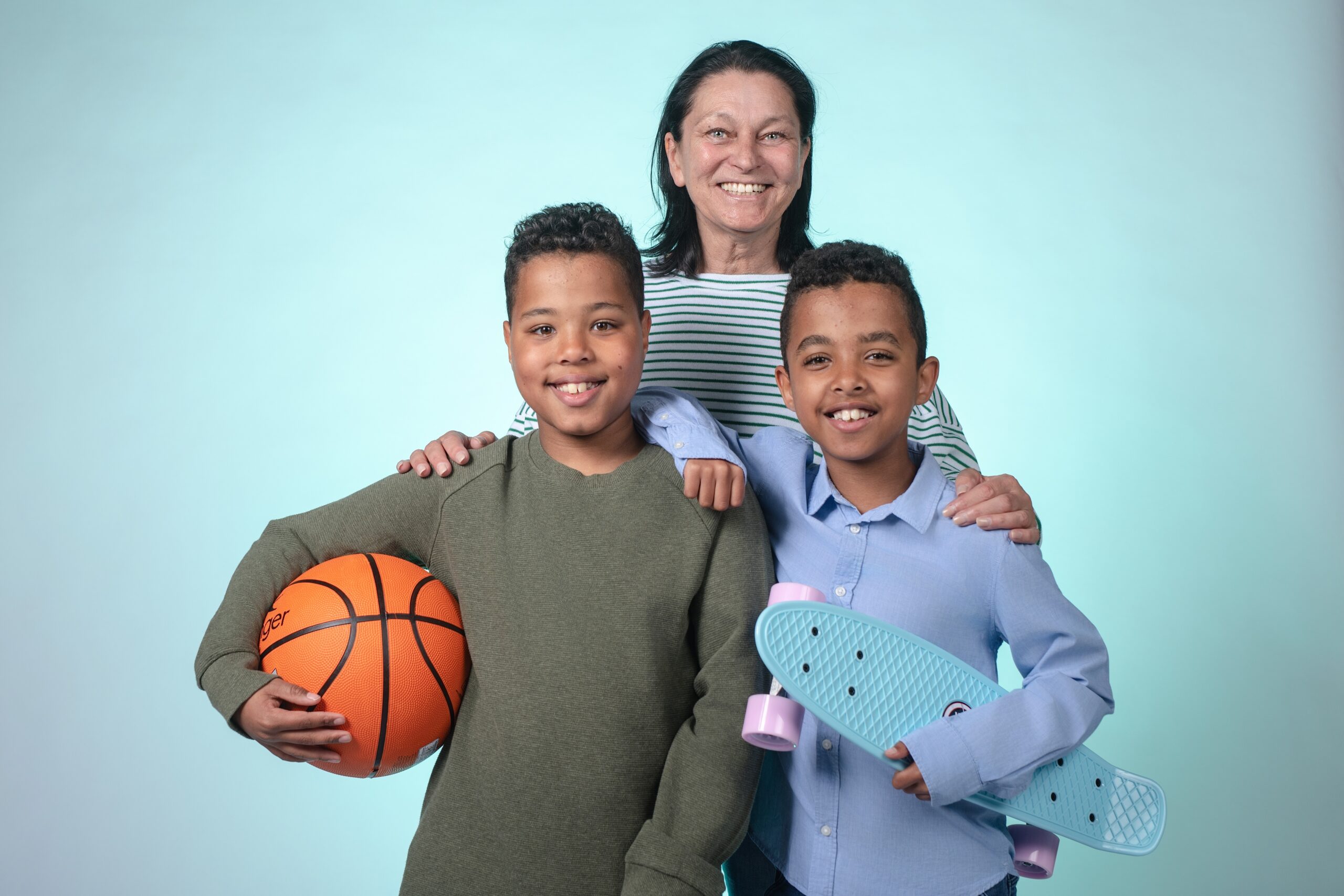



“Being proactive isn’t about mistrust; it’s about self-determination.”
What We Should Know Before Becoming a Single Parent: A Conversation with Sara Buschmann About Courage, Planning, and Resilience
Let’s be completely honest: As (expectant) parents, we hardly ever prepare ourselves for the possibility that we might one day become single parents—even though, statistically speaking, one in three parents faces this situation at some point in their lives. Sara Buschmann, an author and the founder of the nonprofit organization SOLOMÜTTER, is a single parent herself and advocates for greater visibility for single-parent families. In an interview with us, she speaks candidly about structural discrimination, the clichés she’s sick of hearing, and offers tips on how we can—or should?—prepare for the (un)likely event.
Sara, you wrote a book called *The Book You Must Read Before Raising a Child on Your Own*. Why was it important to you to write this book , and what motivated you?
For one thing, it was a personal priority: I would have liked to have a book myself that honestly explains what to expect and conveys that planning for the future has nothing to do with mistrust, but rather with self-determination. At the same time, I’m not the only one who feels this way. One in three parents will experience single parenthood at some point in their lives—and yet this family structure is still stigmatized today. Single parents are often viewed as either having brought it on themselves, having failed, being too emancipated, or being incapable of maintaining a relationship. That annoys me because it paints a completely distorted picture. How much single parents accomplish every day, what challenges they face, and just how hard a separation can hit women in particular—these are topics that are rarely discussed openly. I wanted to show just how much single parents are often underestimated.
You’ve definitely succeeded in that. Just as it is important to highlight the diversity of family structures. You describe single-parent families ranging from those formed by widowhood to those involving co-parenting, all the way to single motherhood resulting from a decision to have children. Despite all their differences, what would you say unites single parents? What do they have in common?
Even though their stories are very different, single parents have one thing in common: they bear an enormous amount of responsibility on very few shoulders. They have learned to make bold decisions, to stand up for themselves and their children, and to organize their daily lives in a pragmatic way. They juggle work, caregiving, appointments, and finances, and in doing so, they develop an impressive strength. At the same time, they are aware of the discrepancy between societal expectations and real-world conditions—and it is precisely this tension that unites many of them.
As you point out, this tension is still historically rooted and associated with many prejudices. In your book, you discuss 10 pieces of nonsense that single parents hear over and over again. Which of these phrases drives you the most crazy? And how do you respond to him?
The phrase that annoys me the most is: “I’m sort of a single parent, too.” Because there’s no such thing as “sort of a single parent.” Being a single parent means that the refrigerator is stocked with food from just one income, and that every bill and every responsibility falls on one person. Anyone who says they’re essentially a single parent because their partner works a lot is certainly feeling overwhelmed—but they do have a safety net. Single parents live without this safety net, and that is exactly what makes the difference. 41 % of all single parents have low incomes, while this percentage is significantly lower among two-parent families.
I’m not trying to compare who has it harder. The point is to recognize that single-parent families are structurally disadvantaged—and that this bullshit phrase does exactly that: it obscures that fact. We can always talk about being overworked. But please, let’s avoid comparisons that don’t help anyone—and make single parents invisible.
Invisible The topic of “being a single parent” seems to come up even when you ask two-parent families about it. I notice in conversations that the topic triggers fear or defensiveness in many people—a mix of respect and a desire not to think about it too much. Why do you think expectant parents and (still) two-parent couples turn a blind eye to this? And what would you want to tell them?
Many people turn a blind eye because the topic immediately triggers a deep-seated fear: the loss of security. It forces us to think about financial dependence, emotional strain, and responsibility—and about how fairly responsibilities are divided in our own relationship. That’s inconvenient. But that is precisely where an opportunity lies: Those who understand how single parents live can shape their own relationships more consciously and take preventive measures. And being cautious isn’t about mistrust—it’s about treating others as equals.
Many of the obstacles faced by single parents stem from structural inequalities. In your opinion, what are the biggest challenges—especially in the first few months?
The first few months are often an emotionally turbulent time that coincides with structural hurdles. A separation or the loss of a partner brings grief, overwhelming stress, and anxiety about the future, while at the same time the children need to be well supported. Added to this are financial burdens, legal issues such as custody and child support, and the challenge of reorganizing childcare and work. What is particularly troubling is that there is hardly any social recognition, and single parents are simply overlooked in many debates about work-life balance.
As a practical guide: What legal and financial matters should you take care of well in advance of becoming a single parent?
It is important to have a clear overview of your own financial situation. This includes having your own bank account, savings, insurance, and the ability to take care of yourself independently. If you are not married, you should address legal issues such as custody and powers of attorney early on.
And couples should openly discuss how they would divide up care and responsibilities in the event of a separation—and whether that fits with the model they’re currently living. I often hear that fathers prefer a shared custody arrangement after a separation, even though they don’t take on anywhere near 50% of the caregiving responsibilities while they’re still in the relationship. Maybe right now is a good time to do something about it. Statistically speaking, by the way, equal partnerships tend to be happier.
If that happens and you find yourself raising a child on your own, what three emergency tips would you give people for the first few weeks?
The first few weeks after a breakup or the loss of a partner are often a time of turmoil. Nevertheless, it is important to keep a clear head and take the most urgent steps immediately. Anyone who is unable to act during this phase may lose money that will be urgently needed later on. For example, many people don’t know that child support must be requested in writing and is paid retroactively only then. That is why you should contact a legal representative, the youth welfare office, or a counseling center as soon as possible. It is equally important not to rush into resolving legal issues such as custody and visitation rights while still in the throes of grief. With legal advice, it is possible to reach agreements that are sustainable in the long term. And finally: Be kind to yourself and accept help. Many single parents feel they have to do everything on their own, but that’s not necessary. Family, friends, neighbors, or coworkers are often happy to help if you ask them specifically. A sentence like, “Can you help me pick up the kids this week? ” can make a huge difference. Accepting help is not a sign of weakness.
Let’s talk specifically about support: Nothing seems to be as important to parents—whether they’re couples or single parents—as a strong support network. What can friends, family, coworkers, or employers do to help?
A good support network is important for all parents—but it’s often essential for single parents. Clear, set arrangements are helpful, such as: Tuesday is Uncle Day, or on Thursdays, Laura goes with Finn. But support begins even earlier than many people think. Before you can help, you should understand how tightly packed the days are, how often plans fall through at the last minute, how much responsibility rests on one person, and how tight the financial situation can sometimes be. This basic understanding alone makes a big difference. And then: Just ask. Don’t give advice or unsolicited tips. Instead, really ask what is needed right now. Single parents know best where the problems lie. A simple “How can I help lighten your load this week?” is often more helpful than any well-meaning suggestion from someone else. It’s similar at work. This isn’t about special treatment; it’s about fair, reliable conditions. Clear agreements, predictable schedules, and true flexibility—that’s worth its weight in gold. Single parents don’t want special treatment; they want a framework that allows them to reliably organize their daily lives. In the end, everyone benefits: the team, the company, and of course the children.
In many cases, the other parent also takes on caregiving responsibilities. So the issue of coordinating with ex-partners often comes into play as well. Only one-third of separated parents describe their relationship as good or very good. Do you have any tips, ideas, or strategies for communication between people who have broken up?
Communicating with the other parent is one of the biggest challenges. Clarity is crucial, especially at the beginning: It’s better to put things in writing than to act on impulse, and better to be objective than to leave room for interpretation. Long WhatsApp discussions rarely lead to solutions; short, concise exchanges are often more helpful. Many parents would like to work together effectively, but sometimes that’s simply not possible. In that case, parallel parenting is not a failure, but a model that can provide stability. It is important to keep children out of arguments. They must not be burdened with financial worries or a lack of child support, and they should not be made to speak ill of the other parent. What matters is not harmony among the adults, but reliability in everyday life. When children feel that things are running smoothly and that both parents are taking responsibility, it gives them a sense of security—even if the adults no longer get along.
One final question to wrap things up: What would you like us all to finally come to understand when it comes to single parents?
It’s important to me that we finally understand: Being a single parent doesn’t mean having a smaller family, but rather a different kind of family. It is not an exception, but a reality we live with every day. One in five families in Germany is a single-parent family. Nevertheless, they are still considered ineffective or a failure today—even though that picture is completely inaccurate. Many single parents are extremely well-organized, solution-oriented, and remarkably resilient. They handle all the day-to-day tasks on their own, often under difficult conditions. When we internalize this perspective, our outlook automatically changes. Then we can begin to make parenting more realistic and supportive overall—for all types of families. Ultimately, it’s not about whether you raise your children as a couple or on your own, but about ensuring that children grow up in stable, loving, and reliable environments.
There are really a lot of important aspects, perspectives, and tips that you address in your book and through your work. Thank you so much for your input, Sara!
Further Reading
Sara Buschmann, The Book You Must Read Before Raising a Child on Your Own, KOMPLETT MEDIA 2025.
Our takeaway: Single-parent families are diverse, well-organized, and often resilient—and they overcome many obstacles and challenges.

This article was published in collaboration with awo lifebalance Weser-Ems.
Are you a single parent or about to become one, and would you like personalized advice? Our experts will be happy to provide you with confidential support: